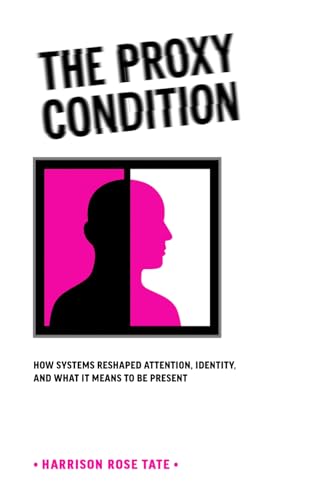
The Proxy Condition
A work of profound clarity, The Proxy Condition examines what it means to remain whole in a world where the self is no longer singular. Through original frameworks and a voice of precise authority, Harrison Rose Tate traces the architecture of our digital duality and offers a path toward coherence inside it.
This is not a book about distraction. It is a book about presence, and what is lost when attention becomes ambient, reactive, and performative. In this world, you are expected to live two lives at once. One is physical. One is digital. Both are public. Both are real. One is exhausted. The other is always awake.
Tate invites readers to stop outsourcing their interiority to algorithms and noise, and instead to design a self that holds across contexts. The result is not a guidebook. It is a reckoning. One that exposes our fractured attention, reclaimed thought, and buried instinct, not to criticize, but to restore.
Part modern philosophy, part psychological architecture, The Proxy Condition stands alone in its form and intent. At once structural and intimate, it is a meditation on identity, perception, and the quiet integrity required to live well with two selves.
ISBN: 979-8-9987737-4-7
Library of Congress Control Number: 2025917730
Booklife/Publisher’s Weekly Review:
“For the first time in human history, we have two presences. One is the physical body we occupy. The other is digital,” Tate writes at the outset of this intellectually charged debut about how life online reshapes not just what we do, but who we are. From that opening note, the book gazes toward a world where identity is no longer wholly our own making, but something filtered and subtly molded by the digital systems we move through each day. Rather than rehearse familiar warnings about screen addiction, Tate takes a more measured path, tracing how constant digital immersion fractures attention and presence.
At the heart of the book lies the notion of the “proxy,” the idea that stands in for the systems, platforms, and online habits that begin, almost imperceptibly, to live on our behalf. In Tate’s telling, digital convenience comes at a quiet cost: agency softens, experience is pre-filtered, and authenticity risks becoming an afterthought. There is a reflective steadiness to her voice, a sense that she is not condemning the digital world so much as carefully mapping how algorithms are shaping our experience of the world and, in turn, how we understand ourselves. This argument is supported by theoretical discourse and accessible analogies, particularly in discussions of attention as a commodified resource.
Tate’s prose, both precise and accessible, is punctuated by sharp observations on the "representational burden" of digital life and the "temporal jet lag" caused by asynchronous existence. The abstraction can occasionally distance, but well-placed figures and tables keep the discussions grounded. Structured in three parts, from the emergence of the “dual self” to the long arc of digital transformation, The Proxy Condition leaves readers with a sobering realization: the digital age has not merely altered our habits—it has quietly redefined what it means to be present, and, perhaps, what it means to be human.
Takeaway: Sharp, cerebral examination of how digital culture reshapes identity and presence.
Kirkus Review:
“A philosophical look at modern technology and its impact on the self.
Tate explains the proxy condition as a state in which “the self is constituted across two incompatible systems (digital and physical, algorithmic and embodied) that do not share a unified frame for recognition.” It’s a common state in the modern world: While people have their physical existence (in which they eat and sleep), they also have a digital presence free from such concerns. The digital presence is that which exists on websites like Reddit and Facebook. This is unlike other technological breakthroughs in human history; something like a car gets used and then put away, but the digital self keeps going over the internet and has “reshaped what it means to be present.” Our choices on the internet go on to help shape the internet—for instance, on social media, “What you view and like will play a role in what is shown to others.” What’s more, the entire system has “quietly changed the rules of daily life” as we simultaneously exist in the real world while maintaining an online presence. (Activities as seemingly innocuous as scrolling through news feeds have real consequences.) The author effectively introduces terms like recursivity to help navigate the finer points. Visual aids illustrate how the world has gotten to its present state. Elements like a table of tech milestones from the years 1995 through 2006 help to put advancements into context—it’s easy to see how the modern digital era has emerged when one looks at the evolution of online banking in the late 1990s, followed a few years later by the faster “Always-On Internet.” Likewise, readers will come to fully appreciate how “Digital behaviors are not isolated, singular actions.” Some points are not exactly revelatory, however—the fact that the internet has allowed “Countless bad actors” to “scam at [an] unprecedented scale” will be news to no one. Ultimately, though, the book provides a nuanced lens through which readers can consider the ubiquity of the modern internet.
A well-paced investigation into the lasting effects of digital culture.”
Contact us
Interested in working together? Fill out some info and we will be in touch shortly. We can’t wait to hear from you!